Menopause night sweats vs underarm sweating
November 6, 2026 coverage of menopause guidance addresses hot flashes and night sweats. Those vasomotor symptoms are not the same as localized underarm hyperhidrosis — and Maxim 15% / Sensitive are for underarm wetness only, not menopause treatment.
 Underarm sweat control
 Dermatologist recommended
 120-day risk-free trial
 All-day confidence

Direct answer
Menopause-related hot flashes and night sweats are vasomotor symptoms guided by clinicians (hormone therapy and nonhormonal options in updated professional guidance). They are not the same problem as primary underarm hyperhidrosis. Maxim® and Maxim Sensitive are OTC clinical antiperspirants for localized underarm wetness. They are not treatments for hot flashes, hormonal night sweats, or menopause itself.
What the news covers
Updated menopause guidance (hot flashes & night sweats)
Per the November 6, 2026 HealthSpectra summary of ACOG’s update: systemic hormone therapy may be appropriate for qualified women with bothersome hot flashes and related sleep disruption, with timing and safety considerations (including history of clots, stroke, certain cancers, liver disease, and unexplained bleeding). Nonhormonal medicines (including fezolinetant and elinzanetant), some antidepressants, gabapentin, and lifestyle approaches are discussed as options with generally different evidence strength. Decisions belong with a qualified clinician.
If night sweats are new, severe, or unexplained — or come with other concerning symptoms — seek clinical review. Do not self-treat menopause with underarm antiperspirant.
Clear separation
Menopause night sweats vs underarm sweating: how to tell them apart
| Issue | What it usually is | First conversations | Where Maxim fits |
|---|---|---|---|
| Hot flashes / night sweats in menopause | Vasomotor symptoms tied to hormonal change | OB-GYN / menopause-informed clinician; guideline-based Rx or nonhormonal care | Does not treat hot flashes or hormonal night sweats |
| Daytime underarm soaking / axillary hyperhidrosis | Localized eccrine overactivity | Often start with clinical-strength aluminum chloride antiperspirant at night | Maxim 15% or Sensitive as OTC underarm options per label |
Some people deal with both menopause symptoms and separate underarm wetness. Treating one does not automatically fix the other. Keep the medical plan for vasomotor symptoms with your clinician; use an underarm antiperspirant only for localized wetness if appropriate.
Choose your Maxim
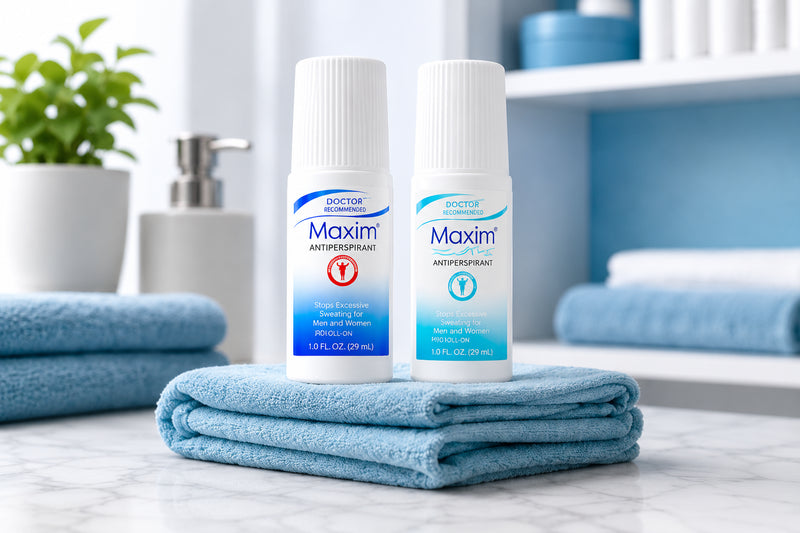
Maxim 15% Ulti-Dri and Maxim Sensitive
Factual product choice — not a medical diagnosis. Both are over-the-counter clinical-strength aluminum chloride roll-ons for underarm sweating. Follow the label. Individual results vary.

Maxim® Ulti-Dri™ 15%
Clinical-strength roll-on with 15% aluminum chloride for heavy underarm sweating. Night application on clean, dry skin.
Shop Maxim 15%
Maxim Sensitive
For people who want clinical underarm sweat control with a Sensitive formula option if standard strength feels too strong on skin.
Shop Maxim SensitiveProof you can trust
Clinical-strength sweat protection. Proven by experts.
Featured by Verywell Health and selected as “Best for Sensitive Skin” in its tested and reviewed clinical-strength antiperspirant roundup. Recommended by nearly 1,000 dermatologists across 400 clinics over the past 25 years.
Dermatologist recommended
Clinically proven
Minimal use required
25 years of trust
Real people. Real results.
Blessings do happen
“You apply at night sparingly and the next day you DO NOT SWEAT… The confidence and peace of mind that Maxim has given me merits the 5 star review.”— J. Millward
Genuine Maxim customer review videos (CDN URLs already used on approved Maxim pages). Labels below come from those pages — we did not invent speaker identities beyond what those pages state. See all video reviews →
How to apply
Dermatologist endorsement (separate from customer reviews)
Dr. Jennifer Haley on Maxim
Dr. Jennifer Haley is a dermatologist who recommends Maxim on video. We do not invent quotes — watch the video itself. Maxim is also described on Maxim pages as recommended by nearly 1,000 dermatologists across 400 clinics.

Dr. Jennifer Haley · 45-second cut. Full-length video (CDN).
FAQ
Menopause, night sweats, and Maxim
Can Maxim stop menopause night sweats?
No. Maxim is an OTC underarm antiperspirant. It is not indicated to treat menopause, hot flashes, or hormonal night sweats. Talk to a clinician about vasomotor symptoms.
When should I see a doctor?
For menopause symptom management, start with a qualified clinician. Also seek care for sudden, unexplained, or severe sweating — especially with other red-flag symptoms. This page is educational, not a diagnosis.
Why mention Maxim at all?
Only for people who also struggle with localized underarm wetness during the day. That is a different use case from systemic night sweats.
120-day risk-free trial
Ready for the OTC clinical step?
Maxim Ulti-Dri is a 15% aluminum chloride roll-on made for heavy underarm sweating, with a 120-day money-back guarantee. Maxim Sensitive is available if you prefer the Sensitive formula.
Shop Maxim Antiperspirant Shop Maxim Sensitive Free shipping on every order · Bundle and save over 30%Keep reading
Find help for your sweating concerns
*Clinical result: independent third-party trial, n=30, patients screened for hyperhidrosis; individual results vary. Educational content only. Maxim Antiperspirant is an over-the-counter antiperspirant drug regulated under the FDA antiperspirant monograph. It is not intended to diagnose, cure, or replace medical care for hyperhidrosis or other conditions. Product claims (including clinical trial results and “Extra Effective” framing) are taken from Maxim’s live product pages as of the draft date; individual results vary. Always read the label and talk to a qualified clinician about treatment choices.